
Artificial Intelligence Automation in Human Resources: Technologies, Challenges, and Best Practices
Large Language Models such as ChatGPT, Gemini, Claude, or custom LLM systems allow organizations to automate communication, document processing, and HR support.

Artificial Intelligence (AI) is transforming Human Resources (HR) by automating repetitive administrative tasks, improving decision-making, and enabling data-driven workforce management. HR departments increasingly rely on AI systems for recruitment, onboarding, performance management, employee engagement, and workforce analytics.
Research indicates that over 50% of HR departments already use AI for talent acquisition and employee engagement monitoring, and many report improved candidate quality and efficiency.
However, while AI automation increases productivity, it also introduces challenges such as ethical risks, algorithmic bias, privacy concerns, and workforce resistance. Organizations must therefore adopt balanced strategies where AI augments human capabilities rather than replacing them.
AI Automation in HR: Core Technologies
AI in HR is primarily based on several technological components:
Large Language Models (LLMs)
Large Language Models such as ChatGPT, Gemini, Claude, or custom LLM systems allow organizations to automate communication, document processing, and HR support.
Typical HR applications include:
Resume screening and summarization
Generating job descriptions and interview questions
Drafting HR policies and employee communications
Automating HR helpdesk support
Creating onboarding materials
Studies comparing HR responses generated by AI tools show that ChatGPT performs slightly better in accuracy and clarity compared to Bard/Gemini (84.3% vs 82.8%), suggesting its usefulness as an automated advisor in transactional HR tasks.
However, these models are best used as assistants rather than decision-makers, because HR processes often require contextual understanding and ethical judgement.

AI Chatbots and HR Virtual Assistants
Conversational AI systems are widely used for employee self-service platforms.
Examples include platforms such as:
Leena AI
Paradox
Talkpush
These AI chatbots can:
answer employee questions
process HR requests
schedule interviews
assist with onboarding
guide employees through policies
Such systems provide 24/7 HR support, significantly reducing administrative workload.
AI chatbots also act as a unified interface that connects multiple HR systems (payroll, HRIS, benefits platforms), allowing employees to access services through natural language queries.
Predictive HR Analytics
AI can analyze workforce data to predict patterns such as:
employee turnover
performance trends
recruitment success rates
workforce skill gaps
Advanced analytics platforms use machine learning to detect patterns in HR data and recommend actions.
Examples include:
talent intelligence systems
workforce planning AI
performance prediction models
Predictive analytics enables HR leaders to make strategic workforce decisions based on data rather than intuition.
AI Workflow Automation
Beyond chatbots, AI is increasingly integrated into workflow automation platforms.
Typical automation examples include:
automatic onboarding checklists
automated candidate screening
HR document generation
performance review reminders
training recommendations
Modern HR automation platforms integrate AI with enterprise software such as:
Microsoft 365
Google Workspace
HRIS systems
collaboration platforms like Slack or Teams.
For example, Gemini integrates directly into Google Workspace to automate HR communications, summarize internal documents, and analyze employee survey data.
Comparison of AI Tools for HR Automation
Organizations implementing AI in HR typically choose between three approaches:
General AI tools (ChatGPT, Gemini, Claude)
Specialized HR AI platforms
Custom enterprise AI modules
ChatGPT
Strengths:
strong natural language generation
powerful API for automation
excellent for writing and summarization
good integration with enterprise software
Use cases:
job description generation
candidate communication
HR policy writing
internal knowledge assistants
ChatGPT is often preferred when companies require flexible AI automation across multiple HR tasks.
Gemini
Strengths:
strong integration with Google Workspace
excellent document analysis
good spreadsheet analytics
Gemini is especially useful for organizations heavily using Google Docs, Sheets, and Gmail, where it can automatically draft HR documents and analyze workforce data.
Use cases include:
HR reporting
survey analysis
workforce data processing
HR communication drafting.
Specialized HR AI Platforms
Examples include:
Leena AI
Eightfold AI
Paradox
These platforms are purpose-built for HR and typically include:
talent intelligence
employee self-service automation
recruitment matching algorithms.
While these tools provide domain-specific capabilities, they may offer less flexibility compared to general AI systems.
Custom AI Modules
Large enterprises increasingly build custom AI solutions using open-source models and internal data.
Typical architecture includes:
internal LLM deployment
Retrieval-Augmented Generation (RAG)
HR knowledge databases
secure enterprise data pipelines
Research suggests that specialized HR-focused AI agents can automate processes such as leave requests, access management, and medical claim handling while preserving confidentiality by avoiding external data processing.
Custom solutions provide:
full data control
better compliance
higher customization.
However, they require significant technical expertise and infrastructure investment.
Challenges and Restrictions of AI in HR
Despite its benefits, AI automation in HR faces several critical challenges.
Data Privacy and Compliance
HR systems process sensitive data such as:
personal employee information
salary details
performance evaluations.
Organizations must ensure compliance with privacy regulations such as GDPR and implement encryption and access control.
Algorithmic Bias
AI models learn from historical data, which may contain bias.
This can lead to:
discriminatory hiring decisions
unfair promotion recommendations
biased performance evaluations.
Therefore, organizations must conduct regular algorithm audits and fairness assessments.
Over-Automation Risk
AI can automate many tasks, but HR decisions often require human judgement.
Examples include:
conflict resolution
culture fit evaluation
employee well-being assessment.
Studies show that over-reliance on AI can lead to automation complacency, where users trust AI output without sufficient verification.
Employee Trust and Well-Being
AI implementation may create fear among employees regarding job security and surveillance.
Research shows that transparency and employee involvement are essential to maintain trust when introducing AI systems.
Visual AI HR Automation Architecture Diagram
┌───────────────────────────────────────────────┐
│                HUMAN INTERACTION              │
│                                               │
│  Employees | HR Managers | Executives         │
│  Web Portal | Mobile | Chat Interface         │
└───────────────────────────────────────────────┘
                        │
                        ▼
┌───────────────────────────────────────────────┐
│                AI INTERFACE LAYER             │
│                                               │
│  HR Chatbot / Copilot                         │
│  AI HR Assistant                              │
│  Voice / Text Conversational Interface        │
└───────────────────────────────────────────────┘
                        │
                        ▼
┌───────────────────────────────────────────────┐
│             ORCHESTRATION & WORKFLOW          │
│                                               │
│  AI Agents / Automation Engine                │
│  Workflow Automation                          │
│  Task Planning and Routing                    │
│  Human-in-the-Loop Approval                   │
└───────────────────────────────────────────────┘
                        │
                        ▼
┌───────────────────────────────────────────────┐
│                 AI MODEL LAYER                │
│                                               │
│  LLMs                                         │
│  - ChatGPT / GPT models                       │
│  - Gemini                                     │
│  - Claude                                     │
│  - Custom enterprise models                   │
│                                               │
│  ML Models                                    │
│  - Recruitment scoring                        │
│  - Employee analytics                         │
│  - Turnover prediction                        │
└───────────────────────────────────────────────┘
                        │
                        ▼
┌───────────────────────────────────────────────┐
│              KNOWLEDGE & RETRIEVAL            │
│                                               │
│  HR Knowledge Base                            │
│  Vector Database (RAG)                        │
│  Document Indexing                            │
│  Policy Repository                            │
│  Training Materials                           │
└───────────────────────────────────────────────┘
                        │
                        ▼
┌───────────────────────────────────────────────┐
│                 DATA LAYER                    │
│                                               │
│  HRIS (Workday, BambooHR, SAP)                │
│  Payroll Systems                              │
│  ATS (Recruitment systems)                    │
│  Performance Management Systems               │
│  Employee Surveys / Engagement Data           │
└───────────────────────────────────────────────┘
                        │
                        ▼
┌───────────────────────────────────────────────┐
│              GOVERNANCE & SECURITY            │
│                                               │
│  Data Privacy (GDPR compliance)               │
│  Access Control & Identity Management         │
│  AI Bias Monitoring                           │
│  Compliance Logging                           │
│  Model Monitoring & Audit Trails              │
└───────────────────────────────────────────────┘
Key architectural ideas
1. Retrieval-Augmented Generation (RAG)
HR knowledge (policies, contracts, procedures) is stored in a knowledge base and vector database. When an employee asks a question, the system retrieves relevant documents and feeds them into the LLM to generate accurate responses.
2. Multi-model architecture
Enterprises increasingly use multiple LLMs simultaneously depending on task complexity and cost.
Example routing:
Simple HR questions → smaller model
HR policy analysis → ChatGPT or Claude
Data analysis → Gemini
Sensitive HR workflows → internal model
3. Human-in-the-loop governance
Critical HR decisions always require human validation:
Examples:
hiring recommendations
performance review outcomes
disciplinary decisions
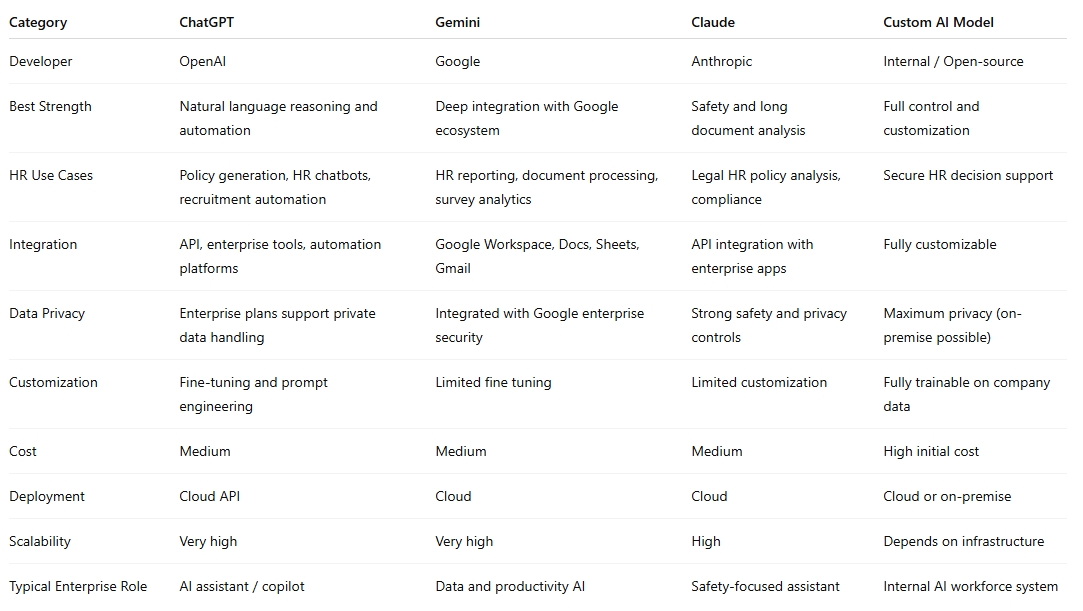
Comparison Table: ChatGPT vs Gemini vs Claude vs Custom AI
Recommended AI Strategy for HR Automation
Most mature companies do not rely on one AI model. Instead they deploy multi-model AI architecture. Example enterprise setup:
ChatGPT → HR Copilot
Gemini → Document analytics
Claude → Compliance review
Custom AI → Internal HR data automation
Benefits:
higher reliability
cost optimization
better accuracy
stronger compliance control
✅ Typical enterprise AI HR stack
Example:
ChatGPT / Claude → HR assistant
LangChain / Semantic Kernel → orchestration
Pinecone / Weaviate → HR knowledge vector DB
Workday / SAP → HRIS
Power Automate / Zapier → HR workflows
💡 Important insight
The future of HR automation is not a single chatbot but a network of AI agents working with HR professionals, combining automation with human oversight.
Best Practices for AI-Supported HR
To maximize benefits and minimize risks, organizations should adopt several best practices.
Human-in-the-Loop Model
AI should support rather than replace HR professionals. Best approach:
AI → Recommendation
Human → Final Decision
This ensures ethical oversight and prevents automated bias.
Transparent AI Governance
Organizations should establish:
AI usage policies
audit mechanisms
explainability standards.
This ensures employees understand how AI decisions are made.
Data Governance and Security
HR AI systems must implement:
secure data storage
anonymization techniques
strict access controls.
Sensitive HR data should preferably be processed in secure enterprise environments or private AI deployments.
Employee Training and Upskilling
HR professionals must learn:
AI prompt engineering
data interpretation
AI governance principles.
Training ensures employees can collaborate effectively with AI systems.
Recommended AI Architecture for HR Automation
A modern AI-enabled HR architecture typically includes:
Layer 1 – Data Sources
HRIS
ATS
payroll systems
employee surveys
Layer 2 – AI Processing
LLM (ChatGPT, Gemini, Claude)
predictive analytics models
knowledge retrieval systems
Layer 3 – Automation Layer
chatbots
workflow automation
HR assistants
Layer 4 – Human Control
HR decision approval
compliance monitoring
bias evaluation.
This layered architecture ensures AI improves efficiency while maintaining human oversight.
What Is Prohibited When Using AI in HR Systems and With Employees
The use of Artificial Intelligence (AI) in Human Resources (HR) systems can significantly improve automation and efficiency, but it also introduces clear legal, ethical, and organizational limitations, especially within the European Union where regulations such as the EU AI Act and the General Data Protection Regulation apply.
These regulations define what is prohibited or strictly restricted when AI is used in employee management and HR decision-making processes.
Below are the most important aspects.
What Is Prohibited When Using AI in HR Systems
1. Fully Automated Decisions About a Person’s Career
AI systems must not independently make final decisions about critical employment matters such as:
hiring a candidate
firing an employee
promotions
salary changes
disciplinary actions
Under GDPR, employees have the right not to be subject to decisions based solely on automated processing if those decisions significantly affect their career.
Therefore, organizations must apply the human-in-the-loop principle, where a human decision-maker validates the final outcome.
2. Use of Discriminatory Algorithms
AI systems must not discriminate against employees or candidates based on factors such as:
gender
age
ethnicity or origin
religion
disability
sexual orientation.
For example, if an AI model is trained on historical data that contains bias, it may start automatically rejecting candidates from certain groups.
Such practices can constitute algorithmic discrimination and may lead to legal consequences.
3. Secret Monitoring of Employees
AI must not be used for covert surveillance of employees. Examples of prohibited or highly restricted practices include:
secretly analyzing employees through camera feeds
emotion recognition from facial expressions in the workplace
tracking keyboard or mouse activity without informing employees
analyzing private communications.
In many European contexts, emotion recognition technologies in workplaces are heavily restricted or considered unacceptable.
4. Processing Sensitive Data Without Legal Basis
AI systems must not analyze sensitive employee data without a valid legal basis. Sensitive data includes:
health information
religious or political beliefs
biometric data
genetic data.
These are classified as special category personal data and require strict legal justification and security protections before they can be processed by AI systems.
5. Manipulating Employee Behavior Using AI
AI should not be used to manipulate employees psychologically or influence behavior in unethical ways. Examples include:
behavioral manipulation using psychological profiling
algorithms that pressure employees into higher productivity through hidden mechanisms
systems that encourage excessive workloads or burnout.
Such practices are considered unethical and potentially harmful to employee rights and wellbeing.
Key Issues Organizations Must Pay Attention To
1. Data Protection
HR systems store some of the most sensitive data within an organization. Organizations must ensure:
strong encryption
strict access control
data anonymization where possible
logging and audit trails.
It is particularly important to ensure that employee data is not sent to external AI models without proper governance and safeguards.
2. Explainability of AI Decisions
Employees should be able to understand:
how AI systems make decisions
what data is used
why a specific recommendation or outcome was generated.
Organizations should therefore prioritize Explainable AI (XAI) models and transparent decision processes.
3. Algorithm Auditing
AI systems must be regularly evaluated and audited. Organizations should monitor:
bias in algorithms
inaccurate outputs
problematic training data.
Many organizations are beginning to implement AI audits similar to financial audits to ensure responsible use.
4. Transparency With Employees
Employees should always be informed if AI systems are analyzing or influencing workplace processes. Organizations must clearly communicate:
what data is being collected
how it is used
how long it is stored.
Transparency significantly improves employee trust in AI systems.
5. Human Oversight
Even the most advanced AI systems should not replace HR professionals in critical decisions. AI should be used to:
generate recommendations
analyze workforce data
automate administrative tasks.
However, final decisions must remain under human control.
Practical Governance Rule for Organizations
A widely recommended approach is the three-level AI control model in HR systems.
Level 1 – AI Assistance
AI helps generate content, summarize CVs, and prepare reports.
Level 2 – AI Recommendations
AI evaluates candidates or workforce data and suggests possible decisions.
Level 3 – Human Decision
An HR professional or manager makes the final decision.
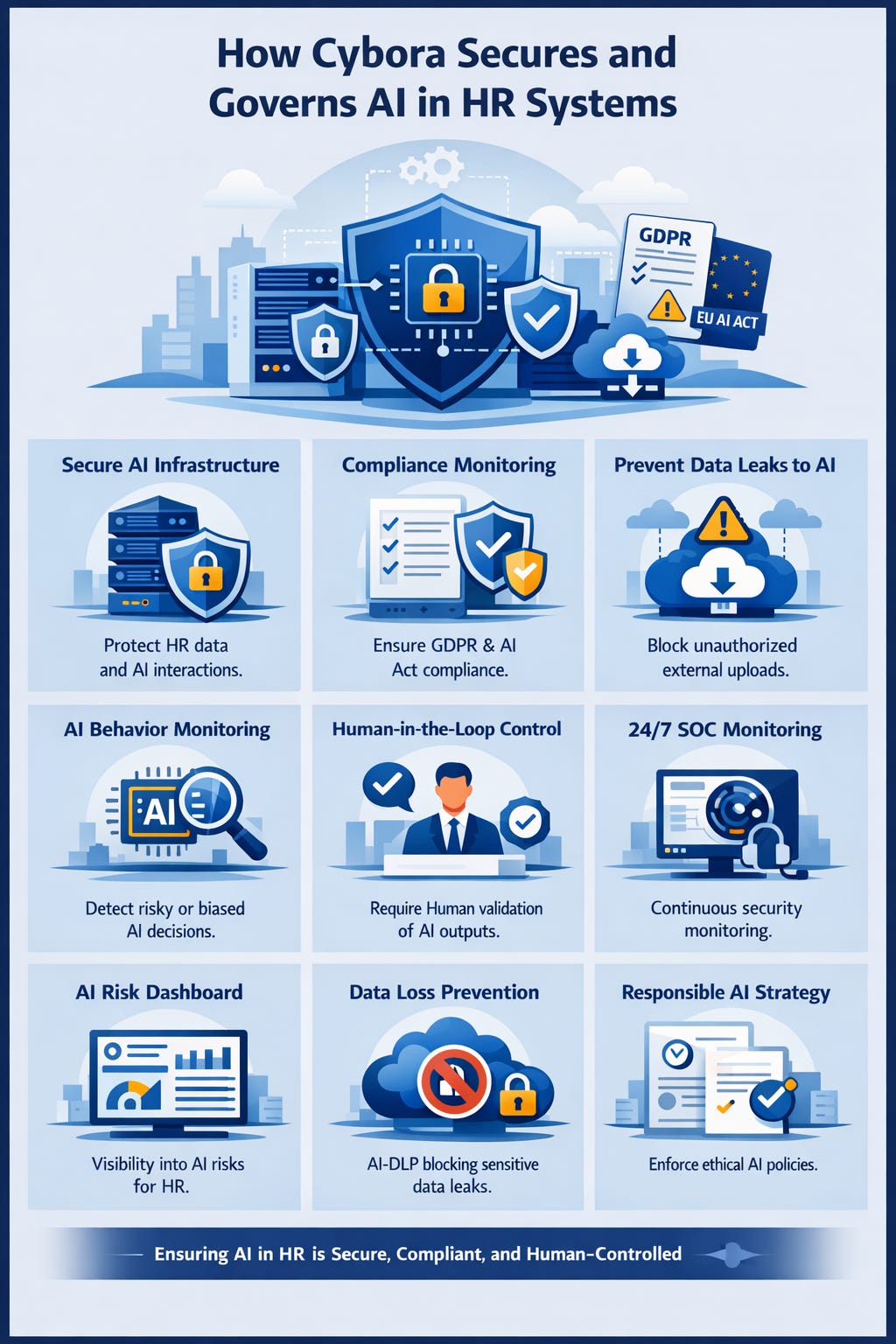
How CYBORA Can Help Secure and Govern AI in HR Systems
As organizations introduce Artificial Intelligence into HR processes—such as recruitment automation, workforce analytics, employee support chatbots, and performance monitoring—the risk surface expands significantly. Sensitive employee data, automated decision-making, and AI model integrations create new security, compliance, and governance challenges.
Cybora can support this environment by providing a secure AI governance and monitoring framework, combining cybersecurity operations, compliance automation, and AI risk management.
Secure AI Infrastructure for HR Systems
HR systems contain some of the most sensitive enterprise data, including personal information, salary data, performance evaluations, and employment records. Cybora can help protect this environment by implementing:
AI-aware security monitoring
monitoring interactions between HR systems and AI models
detecting suspicious API usage or abnormal AI queries
identifying unauthorized data access
Data flow monitoring
tracking how employee data moves between HR systems and AI tools
detecting potential data leakage to external AI services
Identity and access control
enforcing strict authentication for HR administrators and AI systems
preventing unauthorized access to sensitive workforce data.
This ensures that AI integration with HR platforms does not create hidden security vulnerabilities.
AI Governance and Compliance Monitoring
Organizations must comply with regulatory frameworks such as:
General Data Protection Regulation
EU AI Act
Cybora can support compliance by providing automated governance capabilities. Key functions include:
AI activity logging
tracking all AI decisions and interactions in HR workflows
maintaining detailed audit logs
compliance monitoring
ensuring HR AI processes follow data protection rules
detecting unauthorized automated decision-making
AI risk classification
identifying high-risk AI processes such as recruitment scoring or performance evaluation automation.
These capabilities help organizations maintain transparent and auditable AI operations.
Preventing Data Leakage to External AI Systems
One of the biggest risks in HR AI environments occurs when employees upload confidential data to external AI tools. Examples include:
uploading employee performance reports to AI chatbots
sharing internal HR policies with public AI systems
processing employee personal data through external AI APIs.
Cybora can help prevent these risks through:
AI data loss prevention (AI-DLP)
Capabilities include:
detecting sensitive HR data sent to external AI platforms
blocking unauthorized AI usage
alerting security teams when confidential information is exposed.
This ensures that sensitive employee information remains within the organization’s secure infrastructure.
AI Model Behavior Monitoring
AI systems may produce biased, incorrect, or unsafe recommendations.
Cybora can monitor AI outputs and identify potential issues such as:
discriminatory hiring recommendations
suspicious AI decision patterns
abnormal HR analytics results.
Through continuous monitoring, Cybora helps organizations detect algorithmic bias and anomalies in AI-assisted HR processes.
Human-in-the-Loop Control
Responsible AI usage in HR requires that critical decisions remain under human supervision. Cybora supports this by enabling:
decision verification workflows
Examples:
AI suggests candidate ranking
HR manager approves or rejects recommendation
decision is logged and audited.
This ensures AI systems act as decision-support tools rather than autonomous decision-makers.
24/7 Security Monitoring for HR AI Systems
Cybora operates as an AI-assisted Security Operations Center (SOC) that continuously monitors enterprise infrastructure. For HR systems this includes:
monitoring HR databases and applications
detecting unusual access patterns
identifying insider threats
detecting attacks targeting employee data.
Because HR systems are often targeted in cyberattacks, continuous monitoring significantly reduces risk.
AI Risk Visibility for Management
Executives and compliance teams often lack visibility into how AI is used within HR processes.
Cybora provides dashboards that help leadership understand:
where AI is used in HR workflows
what risks are associated with each AI process
how employee data is being handled
whether AI decisions comply with internal policies.
This enables better strategic governance of AI adoption.
Integration With Existing HR Systems
Cybora can integrate with common HR platforms such as:
Workday
SAP SuccessFactors
BambooHR
Microsoft and Google productivity environments.
Through these integrations, Cybora can monitor AI interactions across the entire HR ecosystem.
Supporting Responsible AI Strategy
Beyond technical security, Cybora can support organizations in implementing responsible AI frameworks. This includes:
AI risk assessment
governance policies for AI usage
employee AI usage monitoring
compliance reporting
security automation.
These capabilities help organizations adopt AI safely, transparently, and in compliance with regulations.
Conclusion
AI adoption in HR systems creates powerful opportunities for automation, analytics, and improved employee services. However, it also introduces new risks related to data privacy, security, algorithmic bias, and regulatory compliance.
Cybora can support organizations by providing:
secure AI infrastructure monitoring
compliance and governance automation
AI risk detection
data leakage prevention
human-in-the-loop decision monitoring
24/7 security operations.
By combining cybersecurity expertise with AI governance capabilities, Cybora helps organizations ensure that AI strengthens HR operations while protecting employee data, maintaining compliance, and preserving human oversight.
Artificial Intelligence can significantly improve HR processes, but its use must be carefully governed. Organizations must avoid fully automated decision-making, discrimination, excessive surveillance, and misuse of sensitive employee data.
Successful AI adoption in HR relies on three core principles:
human oversight
data protection
transparency with employees
When these principles are followed, AI becomes a tool that enhances human work and organizational performance rather than threatening employee rights.
Artificial Intelligence is reshaping HR by automating administrative tasks, improving recruitment processes, and enabling data-driven workforce strategies. Technologies such as large language models, AI chatbots, predictive analytics, and workflow automation systems significantly enhance HR efficiency.
Tools like ChatGPT and Gemini provide powerful general-purpose automation capabilities, while specialized HR platforms and custom AI modules offer deeper domain functionality.
However, successful implementation requires addressing critical challenges, including data privacy, algorithmic bias, and employee trust. The most effective HR systems adopt a human-AI collaboration model, where AI augments human decision-making rather than replacing it.
As organizations continue to integrate AI into HR operations, the key to success will be balancing technological innovation with ethical governance and human oversight.